
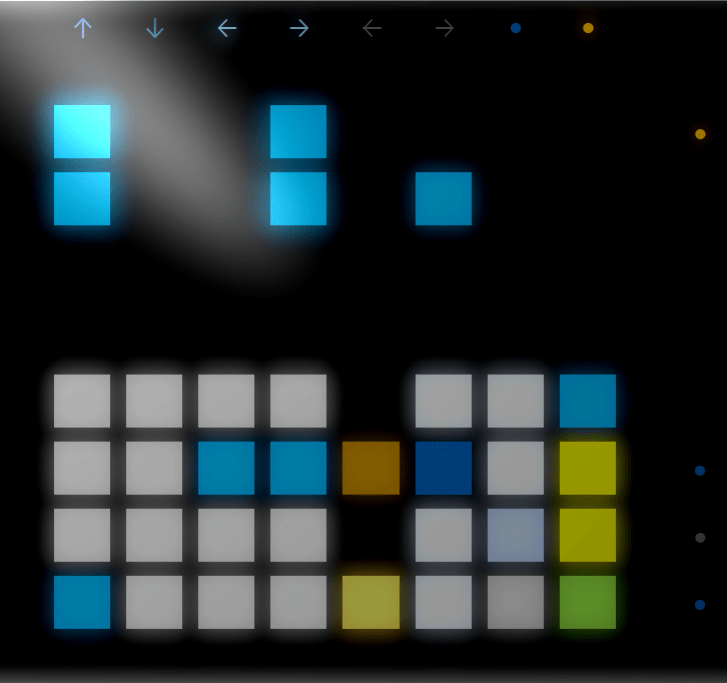
Poly arpeggios are the beating heart of KordsKontrol.
A KordsKontrol poly arpeggio is an “9 channel polyphonic, polymetric, polyrhythmic, polymorphic 64 steps sequencer, with isorhythm functionalities, with 2 CC lanes, 1 dedicated drum lane, trigger probability and velocity per note, note gate length per step and velocity humanization“.
And you have up to 256 of them per session!
We hope you will enjoy them 🙂
Let’s give a few explanations maybe.
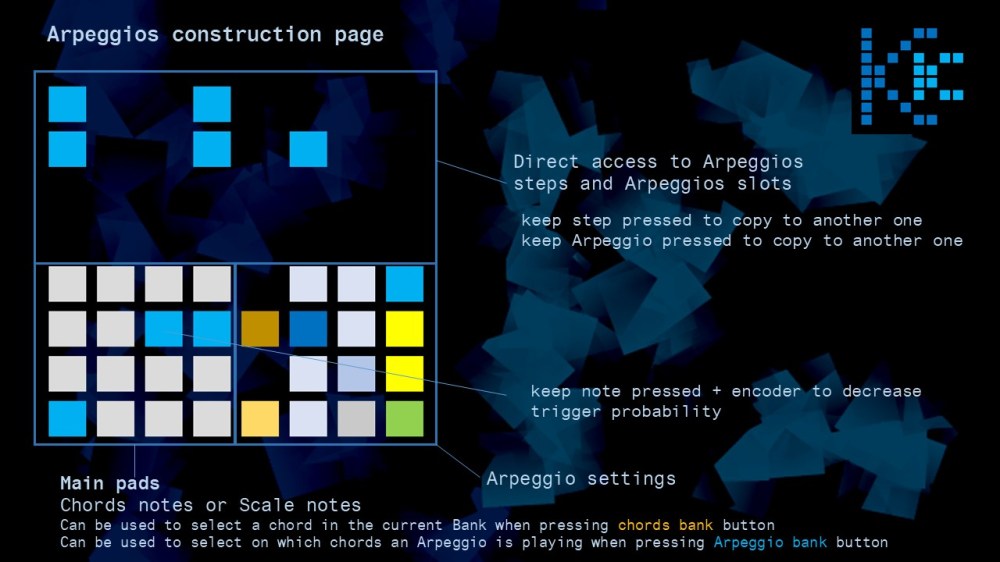
A poly arpeggio doesn’t contain any note information: it only describes which note of the chord (bass, tenor, alto, soprano) will be played for a given step, and at which octave. You can play any arpeggio on any chord, the arpeggio chords notes will always be the right ones! Thus, it is polymorphic.
For each chord, arpeggios notes are sorted in such a manner that when you move from one chord to the next one in the progression, the notes “jumps” are minimized, to get a nice and clean notes sequence.
Since the 2.4 update, it is also possible to record in an Arpeggio scale notes, selecting a position in the scale (for example, the 5th note of the scale), and an octave. Those notes are also polymorphic because it will depend on the scale associated to the chord (but not on the chord itself; thus, you can use it to play a fixed melody in a given scale, independently of the chords of the scale used).
Polymorphic notes are very useful for melodic content, that will evolve with the chords being played, but if you want to sequence Drums, you might be looking for a way to always trigger the same notes out, whatever the chord or the scale that is active. This is possible using the Drum notes sequencing feature, that will send invariable notes on a dedicated MIDI channel.
Each step of an arpeggio can comprise several notes (for example, the first step of an arpeggio can be a chord). Thus, it is polyphonic.
Each Arpeggio can control up to 8 MIDI channels simultaneously! Build a bass line, pad chords and a lead synth on a single Arpeggio! Plus the Drum channel which is specific.
For each channel, the polyphony is 8 notes. Yes, an Arpeggio can play 8 notes plus 8 scale notes on 8 channels, plus 8 Drum notes per step. Be careful not to overload your instruments 🙂
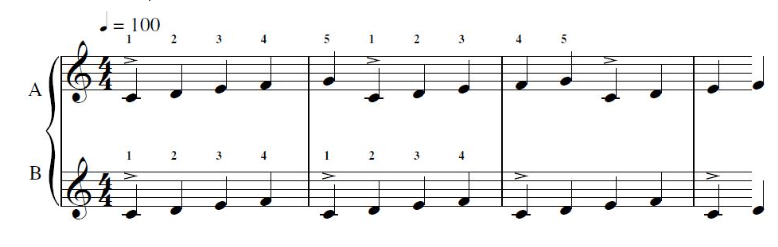
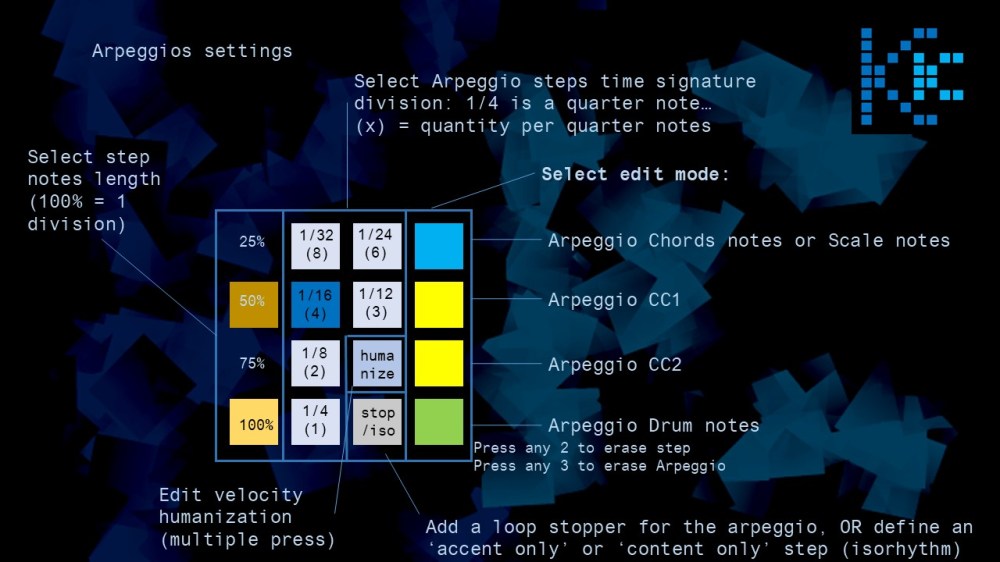
The length of an arpeggio is not fixed: it can be any length up to 64 steps. Each arpeggio will loop automatically when reaching its end; you can also manually select its end point. Thus, it is polymetric. For example, you can run a 5 steps arpeggio in parallel with a 4 steps arpeggio. This will create a movement in the harmony, not having always the same notes playing on the beginning of a bar.
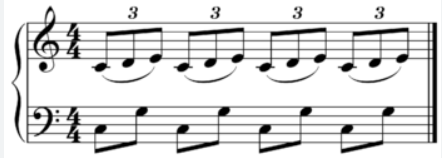
For each Arpeggio, you can choose a different time signature. Thus, it is polyrhythmic. You can play a ternary arpeggio in the same time than a binary arpeggio.
On top of notes sequencing, a KordsKontrol poly Arpeggio can sequence, per step, per Arpeggio and per channel, 2 lanes of CC messages. The CC messages and CC values can be different for the 2 lanes, and between the Arpeggios, and specific to each of the 8 channels!
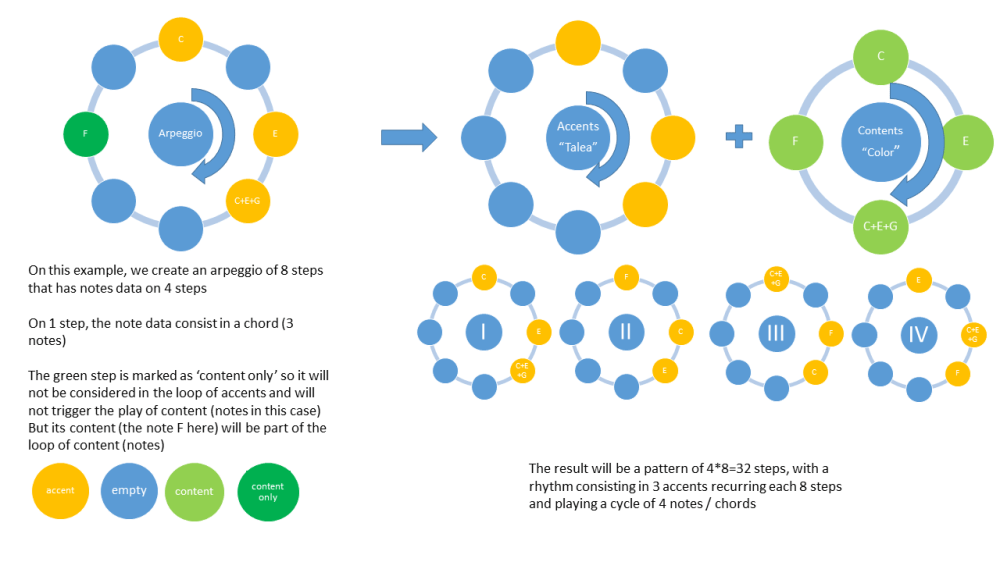
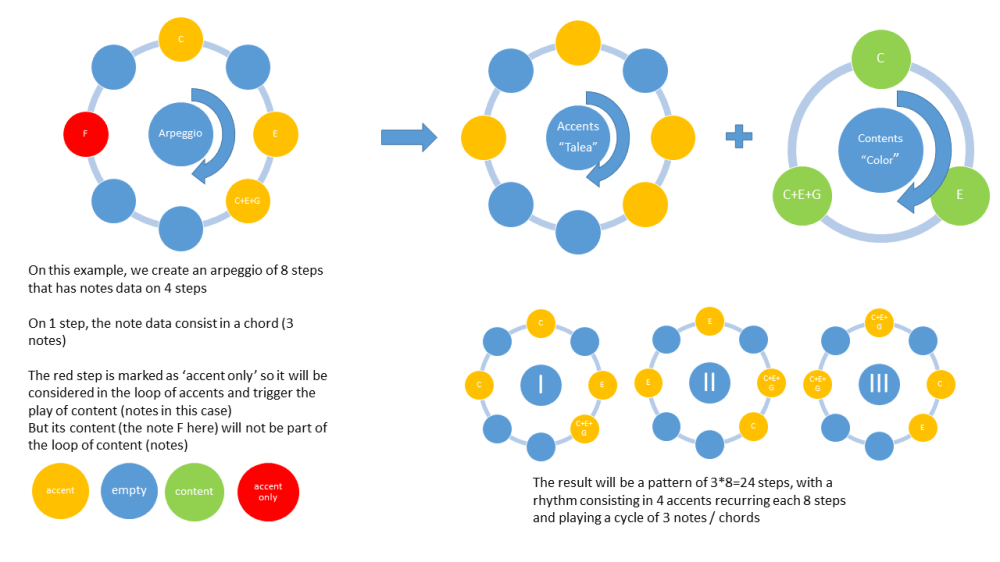
Each step of an Arpeggio can be marked as ‘accent only’ or ‘content only’ using the same button used to mark the end of an Arpeggio loop manually
When a step is ‘accent only’, it means that the notes, CC or Drum notes (content) will be ignored but still, the step will trigger the play of content
When a step is ‘content only’, it means that the notes, CC or Drum notes will be considered, but the step itself will not be played (will not trigger any content)
Doing so, it is possible to define an Arpeggio with less content or more content (means, smaller or longer loop of notes, CC, or Drum notes) than the number of accents being played. Said it differently, to have X accents in an Arpeggio loop (X steps trigerring a play) , and a loop of contents (notes for examples) that have a length of Y elements , with X and Y different and having independant looping length. And thus, to create isorhythms
This is possible for Notes, CC1, CC2 and Drum notes contents independently
KordsKontrol Poly Arpeggio can be humanized also (velocity humanization), and this on a per Arpeggio / per channel basis, for both the notes and drum notes!
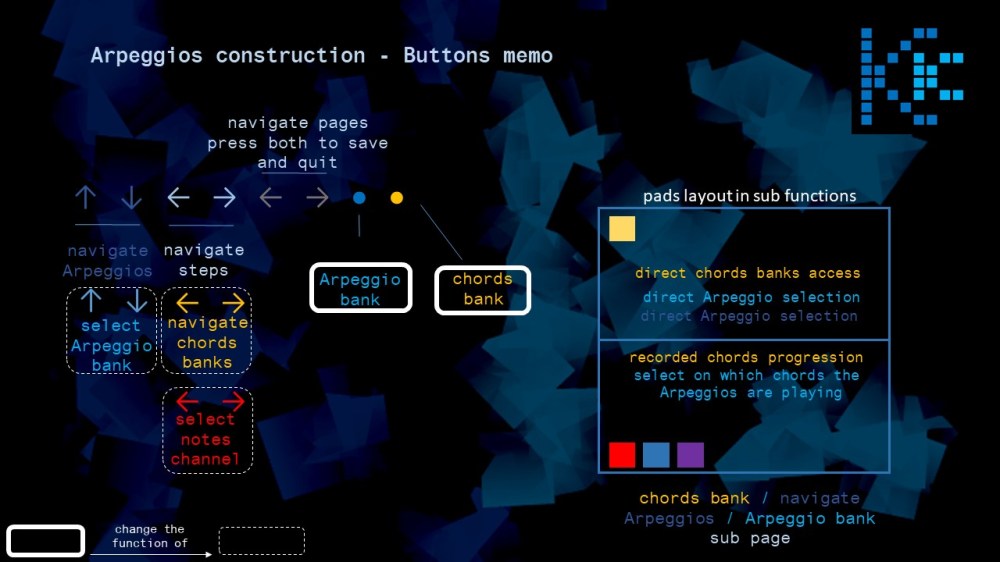
Since 2.45, you can activate / dis-activate Arpeggios to play on only some of the chords of a chord progression, allowing automatic variations of the Arpeggios between the chords of your sequence.
Like chords progression, you can share it with your friends!
 KordsKontrol